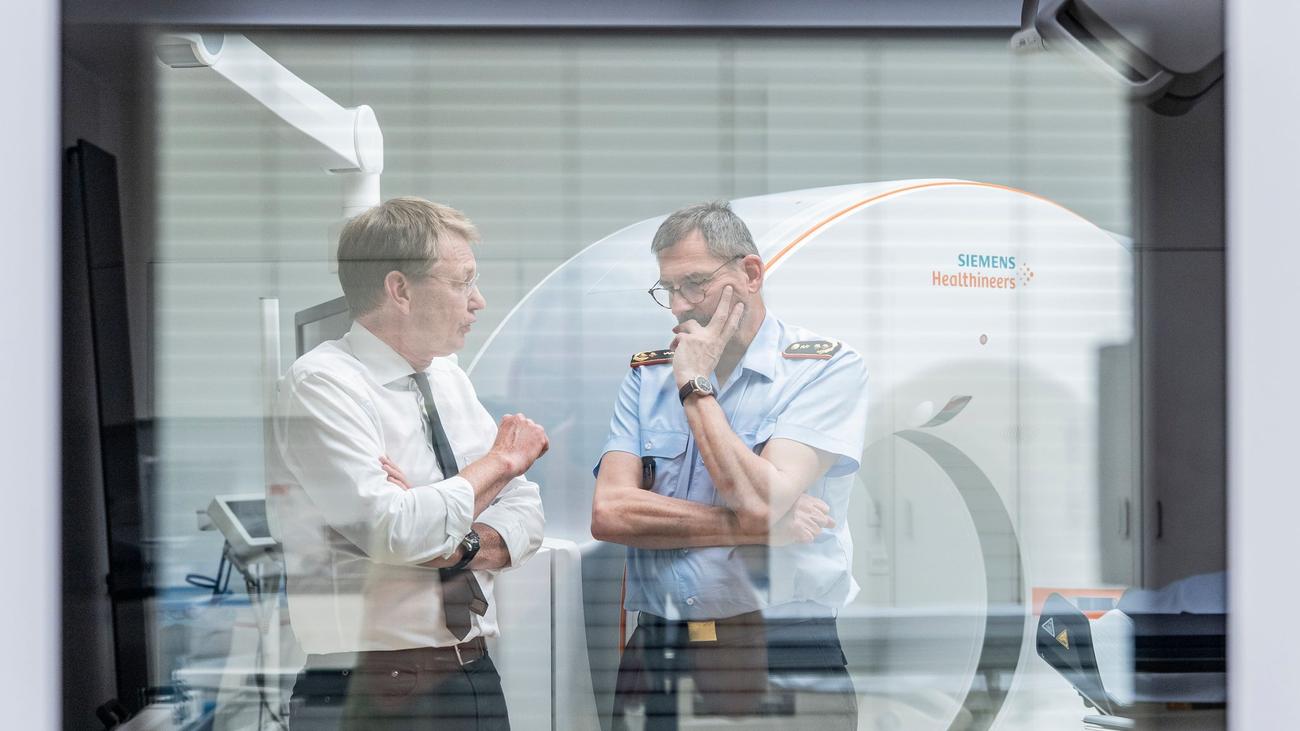
From the helipad on the roof of the Frankfurt College Hospital you go on to the so-called shock room. Within the extremely specialised therapy room, a pc tomograph offers preliminary details about the severity and kind of harm. The Bundeswehr additionally has cell shock rooms that may be transported in containers to completely different places. How nicely ready would our hospitals be within the occasion of a disaster or warfare?
Two males are in shut communication about this: the commander of the Bundeswehr’s well being care command in KoblenzJohannes Backus, and Jürgen Graf, Medical Director of the College Medical Heart Frankfurt and member of the board of the Affiliation of College Hospitals in Germany. The German Press Company was allowed to accompany a gathering solely.
Along with the Bundeswehr Central Hospital in Koblenz, there are 4 different Bundeswehr hospitals in Germany; in Hesse none of them lie. For a “resilient well being construction” in peace, disaster and warfare, as Backus calls it, civilian clinics are important as companions.
The college hospitals, which often belong to the federal states, play a particular position, says Graf: “We’re the operational reserve of the Bundeswehr.” One other pillar are the skilled affiliation clinics and the miners’ hospitals, that are capable of deal with complicated warfare accidents.
“Financial insanity”
What instances are we speaking about? The “worst case” can be a protection case – a warfare on German soil. “There are situations for which we can not put together for each single element,” says Backus, referring particularly to the rehabilitation of warfare injured folks. “To place this right into a reserve construction can be financial insanity.”
“You possibly can’t practice greater than 1,800 hospitals in Germany for particular scientific photos that will by no means happen,” says Graf. There are at present just a few facilities and consultants for accidents typical of warfare, however their data might be “scaled if mandatory”.
The Bundeswehr’s Well being Care Command is at present actively getting ready for the so-called alliance occasion – when a NATO member nation is attacked and the Bundeswehr is deployed there. On this case, medical models can be deployed to the operational space with the fight troops. However, the hospitals within the space would nonetheless face an extra burden.
Along with the “warfare” situation, there may be the “disaster” situation: What to do within the occasion of a “mass casualty incident”, i.e. if the variety of sick folks exceeds the common capability of the emergency providers, because the Federal Workplace for Civil Safety defines this case?
When sources are scarce, the main focus will not be on the quickest however relatively the simplest assist. That is the place a time period comes into play that frightened many individuals in the course of the corona pandemic: triage – the categorization of sufferers based on urgency. Nonetheless, this method is regular for army docs and emergency medication, as Backus explains.
The experiences from the pandemic are useful when constructing buildings. “Now we have realized that federal buildings should be harmonized and sources pooled,” says Backus, “as a result of it doesn’t work nicely in main crises when 17 our bodies – the federal authorities and 16 federal states – need to observe their very own plan.”
The Bundeswehr medical service has proposed bundling Germany into 4 areas (clusters), constructing on the already established “cloverleaf” system from the pandemic. Since then, there was a central “inpatient care planning staff” in Hesse’s civilian hospital panorama.
It is about extra than simply caring for sufferers. For instance, how to make sure that the provision of remedy doesn’t cease, or how communication works even with out the Web.
The Bundeswehr has “a number of expertise with crises of every kind,” says Backus: the pandemic, the Ahr Valley flood, many refugees arriving on the similar time – the Bundeswehr, civilian authorities and hospitals have already labored collectively all over the place. Situations of this sort additionally embody aircraft crashes, excessive warmth waves or widespread energy outages.
“Well being safety” is excessive on the Frankfurt College Medical Heart’s “Technique 2030”. What is important “to take care of provides in a number of disaster situations,” because the subtitle of the 2026 version reads?
Nonetheless quite a bit to do
One element is the particular isolation unit for extremely contagious sufferers, which is liable for the federal states of Hesse, Rhineland-Palatinate and Saarland. Lately, cruise ship passengers have been screened right here following a hantavirus outbreak. One other level is an inventory of “medical provides for disaster conditions” – what’s on it should all the time be in inventory.
“Nonetheless, the general good preparation and the excessive precedence positioned on well being safety can not and mustn’t obscure the truth that there may be nonetheless quite a bit to be accomplished,” says the technique paper.
© dpa-infocom, dpa:260607-930-184083/1