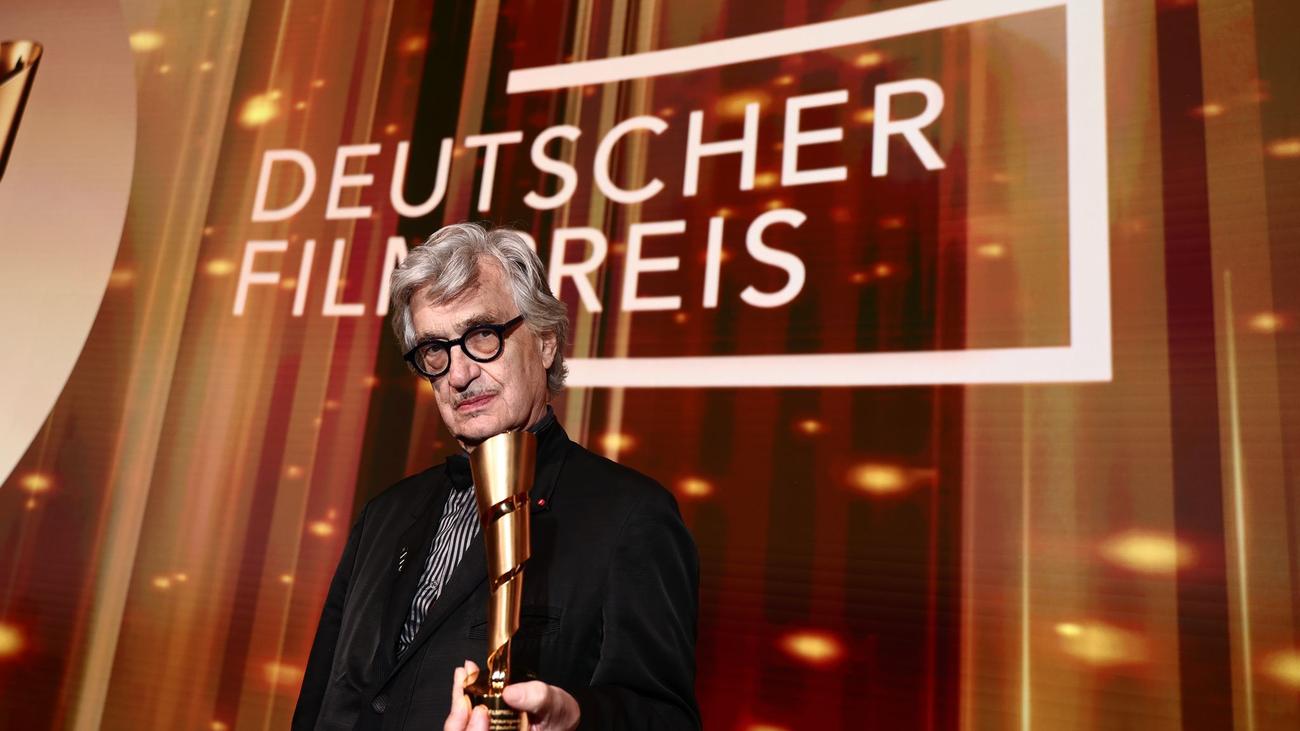
One may count on many moments that would occur on the German Movie Prize, however maybe not this one: It says director Wim Wenders on stage and accepts the honorary award. Together with his distinctive glasses and bow tie, he seems to be considerate and a bit below the climate. After which the 80-year-old talks about one thing that not too long ago made headlines.
In his film In “False Motion” (1975) he labored with actress Nastassja Kinski. She was simply 13 years previous on the time and was nonetheless proven shirtless in a questionable scene.
“Though I didn’t know that a lot once I was 13, I already observed that it wasn’t okay,” Kinski not too long ago instructed the “Süddeutsche Zeitung”. Based on the report, she has been making an attempt to have the scene faraway from the movie for years. On the award ceremony German Film Prize In Berlin, Wenders will now communicate in entrance of round 1,900 invited company.
“Are you able to shorten a movie afterwards?”
He does not simply discuss how he as soon as took half in a movie shoot Senta Berger screwed up as a result of he did not know the way to cope with girls, but additionally in regards to the scene with Kinski. He says that he would not shoot it like that as we speak, however that he additionally has a much bigger query: How do you cope with movies that have been made in a distinct time?
And this query – it is nearly an attraction – considerations all filmmakers. Can and do you have to reduce a scene if it hurts an actress – “whom I like and admire very a lot”? “Are you able to shorten a movie afterwards?” He’s just about alone with this query. “And I’m at a loss too,” added the director. It’s a ethical query.
What the successful movie is about
The second is one which determines the gala on Friday night. And it additionally matches the movie that wins essentially the most awards. “Trying into the Solar” is a movie that explicitly offers with feminine experiences. Director Mascha Schilinski tells the story of 4 girls who dwell on a farm within the Altmark on a number of time ranges.
Whereas the movie didn’t make it to the ultimate spherical as a German entry on the Oscars, it gained ten awards that night in Berlin, together with the Golden Lola for greatest function movie. Actress Lena Urzendowsky, who was awarded greatest supporting actress, then makes use of her speech to name for empathy.
“We’ve to speak to one another, speak in confidence to one another and be there for one another,” she says, visibly moved on stage. Her palms are shaking. Violence of any variety, crossing boundaries and, above all, not being there sufficient for one another should cease.
A number of political messages
It is not the one political message of the night. One query prematurely was how the assembly between the movie trade and the Minister of State for Tradition was Wolfram Weimer (unbiased) involves an finish after quite a few controversies. However other than occasional boos and moderately restrained applause for Weimer, the gala, which lasted a number of hours, remained comparatively unconfrontational.
Ingo Fliess, the producer of the political thriller “Yellow Letters” by İlker Çatak, alludes to the debates in regards to the German Bookstore Prize and the Berlinale on stage, whereas competition director Tricia Tuttle can be there.
He loves how individuals can dwell and work on this nation, says Fliess as he accepts the Silver Lola for “Yellow Letters”. «We’re free. For instance, within the presence of the Minister of State for Tradition, I can specific my shock and bewilderment in regards to the occasions surrounding the bookstore value with out having to concern sanctions. There may be then applause.
There shall be warnings in regards to the AfD that night, for instance from academy boss Florian Gallenberger. Moderator Christian Friedel additionally made it clear and defined that he was very involved about his hometown of Magdeburg and the upcoming state elections in Saxony-Anhalt. He remarks: “Anybody who has ever been blue is aware of how shitty you are feeling the subsequent morning.”
With a whole lot of singing, Friedel leads by the night, which is briefly interrupted on account of a technical drawback. Some individuals stand smoking in entrance of the constructing in the summertime night warmth. Such evenings might be lengthy, a lot of prizes and many speeches.
Director Leander Haußmann’s eulogy causes irritation amongst some viewers, for instance when he mispronounces the identify of the director İlker Çatak and feedback on the second (“The German’s concern of claiming Turkish names”). Çatak gained the Golden Bear on the Berlinale in February together with his movie “Yellow Letters,” the primary German director to take action in additional than 20 years.
Private second with Senta Berger
Issues get notably private when Senta Berger is honored. The actress receives a movie award as greatest actress within the ebook adaptation “Oh, this hole, this horrible hole” by her son Simon Verhoeven. The tragicomedy wins Lola in bronze. It is usually Verhoeven who acknowledges his mom on stage and provides her a kiss. «While you make a movie together with your mom, it naturally results in the director consistently saying “Mother” on set. Which is not essentially excellent or conducive to authority, however on this case it was fantastic.”
One factor that may stay from the movie award is the query that Wenders requested. Relating to the talk about his controversial movie scene, he says he want to see the German Movie Academy talk about the subject, particularly with youthful individuals. “I don’t need to carry it alone.” Assuming he cuts the movie, that will be a precedent that impacts “all of you.” «Then it will likely be doable later for all different movies. I need to talk about it and I do not need to be alone.”
© dpa-infocom, dpa:260530-930-149369/1