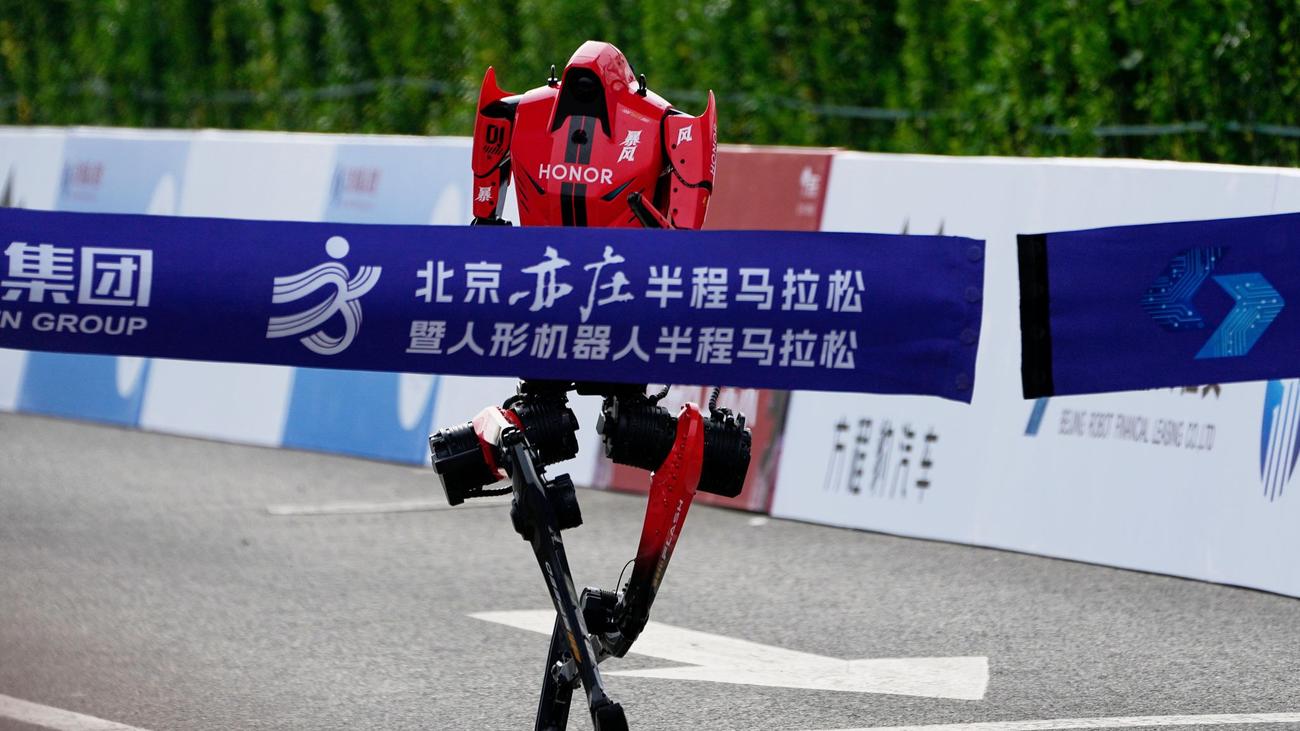
Throughout a half marathon in China Robots have outrun human competitors for the primary time. In Beijing, the remote-controlled model of the humanoid “Blitz” from the smartphone producer Honor’s crew was the primary to cross the end line after 48 minutes and 19 seconds, regardless of a fall shortly earlier than the tip, as might be seen on state tv.
As a result of the foundations for remote-controlled robots add further time, the time was corrected to round 57 minutes. The winner was one other “Blitz” within the autonomous model, which crossed the end line after 50 minutes and 26 seconds.
The perfect time of two hours, 40 minutes and 42 seconds set by the “Tiangong Extremely” robotic from final yr was considerably overwhelmed. The prevailing human half marathon world document is 57 minutes and 20 seconds.
The variety of growth groups from firms and universities was 5 occasions larger this yr, which is why dozens extra humanoids took half. Some crashed alongside the best way or crashed into the confines of the racetrack.
Robots in TV and on a regular basis life
In China, the place the Communist Get together promotes so-called embodied synthetic intelligence and needs to place the nation in a management place, the robots have lengthy been seen at commerce festivals or in TV gala exhibits as dancers or boxers within the ring.
There may be now additionally a Chinese language robotic roaming round in Poland. Edward Warchocki, because the humanoid known as, lately drove wild boars there and made the rounds on the Web. The robotic comes from the corporate Unitree, a pioneer that Chancellor Friedrich Merz (CDU) visited on his journey to China.
PR stunt or scientific progress?
China emphasizes taking a “human-centered” method to creating synthetic intelligence. What this implies is that the expertise ought to assist folks. However what are the advantages of half-marathon operating robots?
Lorenzo Masia from the Technical College of Munich sees this as an vital stress take a look at for the robots. “Protecting a distance of 21 kilometers requires not solely environment friendly locomotion, but in addition robustness, power administration, thermal stability in addition to dependable notion and management over longer intervals of time,” says the director of the Munich Institute of Robotics and Machine Intelligence.
Extended locomotion forces builders to deal with key bottlenecks corresponding to battery energy, sturdiness of motor drive models, real-time management and fault tolerance, says Masia.
The place the robots might be helpful someday
Humanoid robots that run lengthy distances are most likely not utilized in on a regular basis life. The professional on China’s digital economic system, Liu Xingliang, says: “It is not about who can run sooner, however who’s getting nearer and nearer to helpful robots.” Liu sees use circumstances in service or family settings to assist the aged, or in human-hazardous environments corresponding to fires or rescue operations.
© dpa-infocom, dpa:260419-930-963575/1